 I’ve noticed that the 2001 edition of Lovecraft’s Poetry, The Ancient Track, is getting harder to obtain, so I thought I mention it here, since the previous collected poems was back in 1963.  This is the volume edited by S.T. Joshi and published by Nightshade Books.  While I enjoy Lovecraft’s poetical works, I do not consider myself much of an expert on them.   They reveal an interesting facet of Lovecraft’s work since from an early age he had designs on being among the great poets.  Weighing in at more than 500 pages, it is the most complete compendium of all of Lovecraft’s surviving poetry.  Several sellers can be reached through Amazon, and it goes for about thirty dollars.  So, if you’re completing your Lovecraft collected works, you may want to catch this one before it goes out of print.
Vanishing Poems
Dec 27
Making perfect circles is pretty important to creating the illusion of mechanical things. Â Fortunately there are lots of ways to do this, such as as using round alphas, but did you know you could quickly paint circular displacements right on to any hires geometry? Â It’s called radial symmetry and it’s really quite simple to use. Â Just click on the “(R)” button on the transform pallet and set the number of copies of your brush you need. Â Set it really high (up to 100) and then you can quickly spin-up perfectly circular ridges. Â The clay brush will keep these ridges perfectly level. Â It’s a pretty easy 1-2-3.
Â
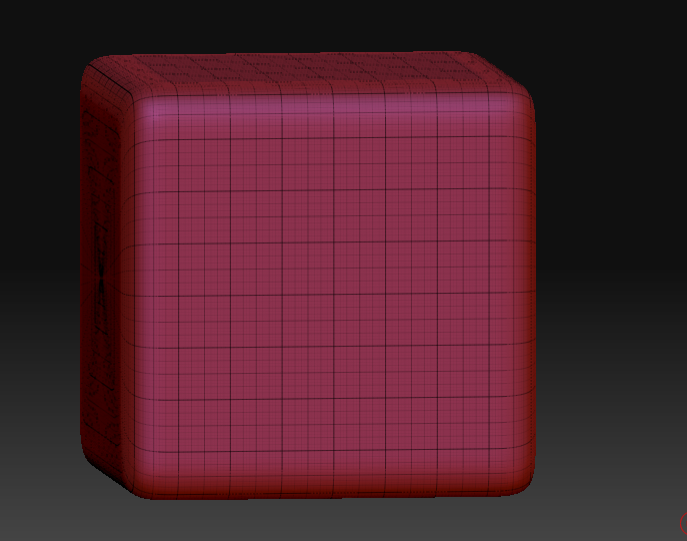
Plain Cube Subdivided
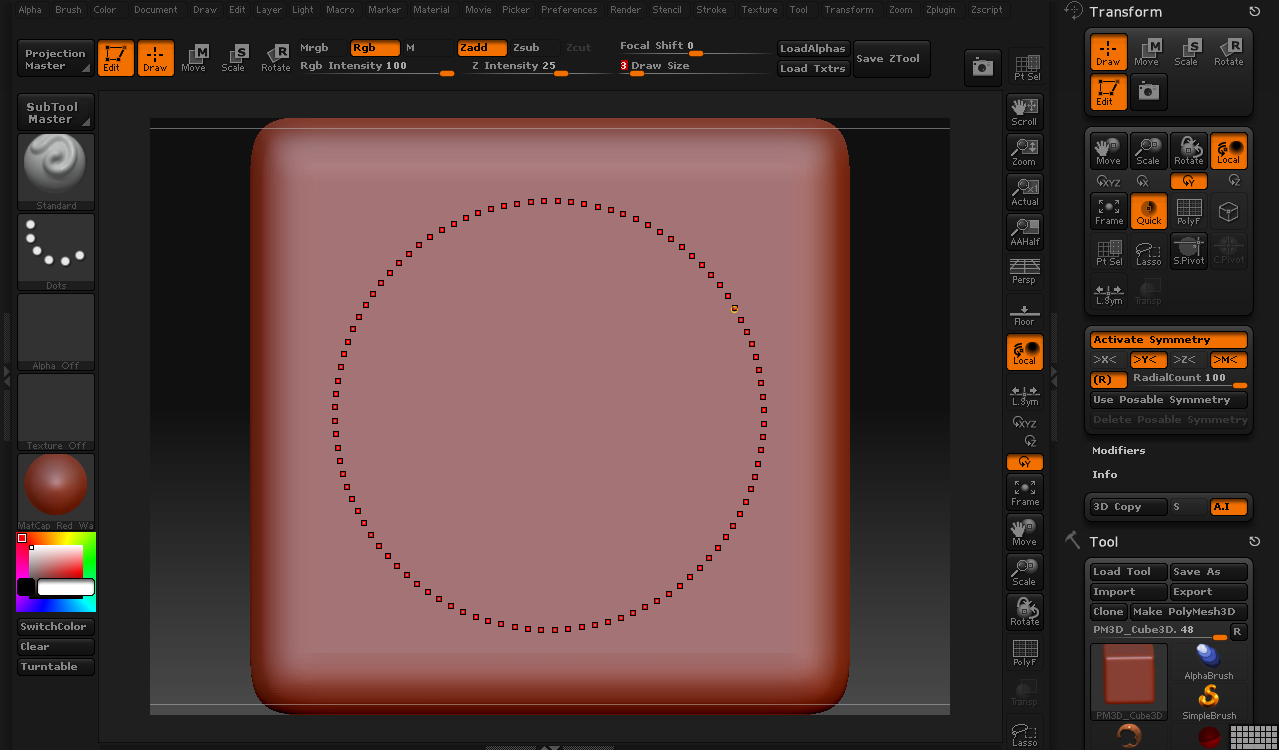
A Radial Symmetry Brush

A detailed cube
There’s always a lot of discussion about “Can you do mechanical modeling in Zbrush?”  The answer from one camp is “No, the soft modeling orientation of ZB makes it too hard. . . .”  Another camp will say, “But look at the results some guys like Meats Meier can get!”  Â
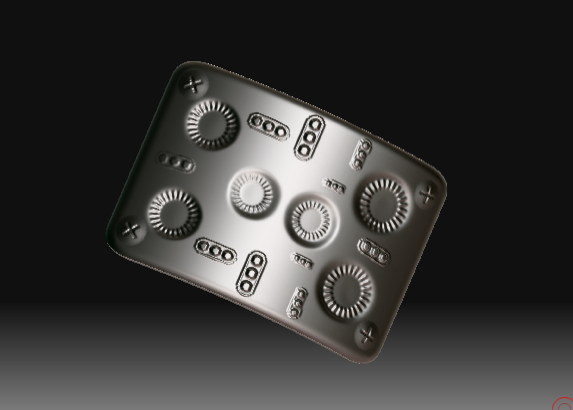
The answer, as with lots of things in life, lies somewhere in between.  ZBrush requires you to think about your mechanical models as if you'[re working with clay.  This means that you need to think of your tools as being built up from things that already have structure, like platonic forms of cubes, cylinders, cones, etc.  Often the trick is to start with something that has approximately the  right shape and work to refine from there. Â
For example, I wanted to make a curved plate.  I realized the plate was really a segment of a cylinder.  After create a Cylinder from Zbrush’s primitives, I turned it into a polymesh (with the “Make Polymsh3d” button).  Them I hid all the geometry of cylinder other than the curved segment that represented my plate.  Fortunately the edges were going to be roughly square as is ZBrush’s selectionÂ
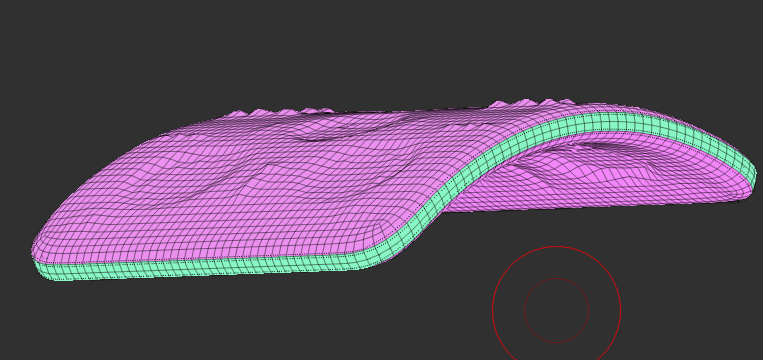
Automatic Polygroups with "Extract"
tool.  With just the mesh I wanted to be the basis for my plate visible, I went to the Subtools sub-pallet of the tools menu, and used the big “Extract” button.  In one step, the visible shape was extracted and given thickness.  (The sliders next to the Extract button will let you play with smoothness and thickness to your liking.)  Even better the front back and the edge of the plate all had new subgroups!  Neat!
For the plate in the illustration, I just used some alphas I had to decorate after subdividing the mesh to a fine detail.  Codeman Studios makes a nice set of Alphas if you’re looking for a profesional set, but there are pleanty to choose from on the web.  For applying the alphas, I used the drag-dot brush and turned on X and Z symmetry as needed.  To ensure my symmetry was good, I used the “S. Pivot” command to set the pivot to the center of the mesh.  (S. Pivot works by hiding everything but central mass of an object and it will move the pivot to the geometric center of what is visible.)
A Cool Reading
May 19
 I just had a chance to listen to Audio Realms recording of At The Mountains of Madness, read in unabridged form by Wayne June.  It’s on four CDs and racking in at 4h45m it’s perfect for a long plane trip.  There are no special tricks, no musical accompaniment or special effects, just Wayne June’s magnificent voice reading the tale as our narrator, Professor William Dyer, as he unfolds his tale of adventure and ultimate horror in the Antarctic wastes.  The story is riveting and June’s reading is most effective as the near mad narrator, desperate to tell his tale.  At USD $27.95, it’s about on par with typical audiobook prices, though it can be downloaded for half that from Audio Realms online distribution site, TheAudioBookshop.Com (USD $13.98).  Whether as a CD or download, it’s well worth the price.
Unforgiven
Jun 7
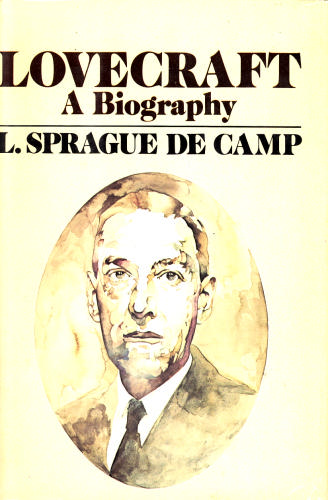 I finished rereading L. Sprague De Camp’s biography of HPL, Lovecraft: A Biography. Reading it some 25 years later is an interesting and somewhat refreshing experience. De Camp has been often criticized by HPL fans for his frank and almost drumming investigation of HPL’s xenophobia and other potential psychosis. Many feel he hurt HPL’s reputation by calling attention to what can easily be perceived as elitism, racism, antisemitism, etc., but in examining the text fully I think De Camp successfully shows that his extreme dislikes and even rages against Jews, Blacks, Catholics, Italians, Celts, Asians, and in fact anyone not of New England Protestent stock is truely a mental disease which he struggled with up to the end of his life. I think the text and quotations of Lovecraft’s letters bear out he had a mental illness, classed as xenophobia which represents a patent fear in general of anyone not of his own race, family, or tribe. To HPL’s credit, and De Camp brings this out, HPL repudiated many of these beliefs. After all, he married a Jew and numbered more than one Jew among his closest friends.
I think some other biographers have often tried to whitewash the negative traits of HPL’s personality, either by excusing him as being from a different era, or suggesting that HPL simply made racist remarks purely for shock value, which he did not truly believe. I think De Camps research, collected information from friends, and HPLs own words shows how the insular and isolated developed opinions and beliefs that were both unsupported by fact, but obviously generated great fear in the insecure writer from Providence.
De Camp also makes much of discussing Lovecraft’s failures of responsibility, including failures to his wife, his craft, and ultimately himself. As working writer who made his career in fantastic fiction, De Camp, is very unsympathetic and unwilling to forgive how HPL choose to live his life (e.g. that HPL fled from the possibilities of being a professional author and instead took on the pose of an impoverished aristocrat, who merely wrote fiction as a “amature” hobby.)
Here, I feel that De Camp is a little harsh and unforgiving that HPL did not make the choices that would seem to have led HPL to write more and be more successful. But that assumes that HPL was destined or responsible to living a conventional life of a professional author and that his choices should have been De Camp’s. HPL lived a unique life of his own making, fraught with the poverty, errors, joys, and successes he chose to live. De Camp’s biography makes that abundantly clear.