The HPL Picture Book

Here’s a fun little book.
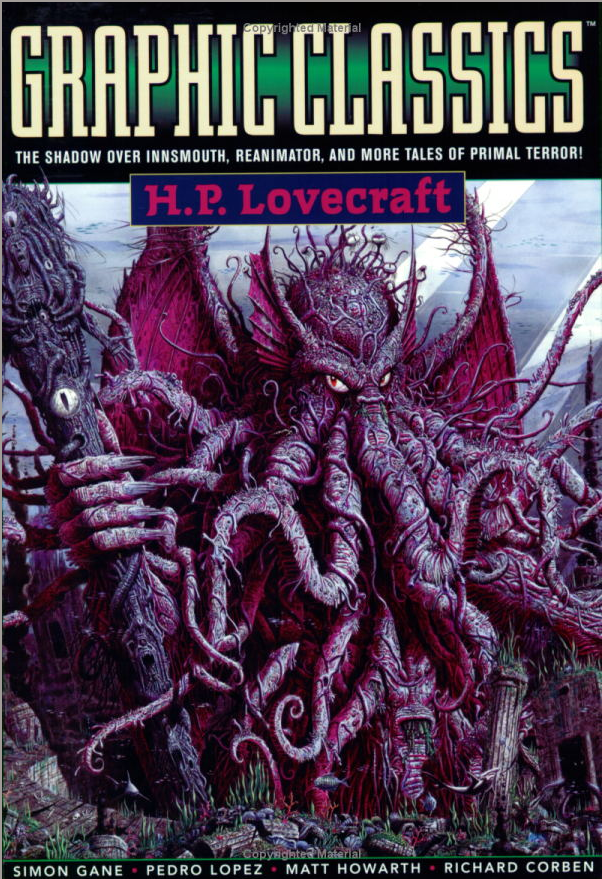
GCHPL.png

Graphics Classics has put out a collection of illustrated HPL stories. A 140 pages of graphic fun, it has the Shadow of Innsmoth, Herbert West, The Cats of Ulthar and others. Some of the drawing styles are little crude, and it is in black and white, but it still fun to look at the visual interpretations by artists Simon Gane, Pedro Lopez, Matt Howarth, and Richard Corben. Its available for less ten dollars from Amazon.
Tags: , , , ,

Philosophical Biography

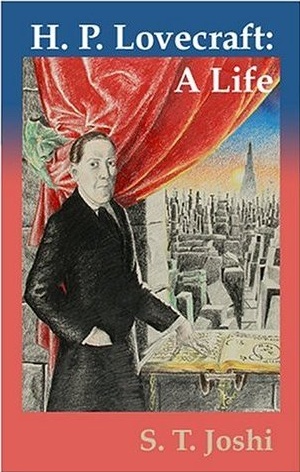
HPLCover.jpgI haven’t been through S.T. Joshi’s work on HPL’s life in a while, so I decided to undertake his massive tome, H. P. Lovecraft: A Life. Joshi’s work stands as the definitive effort to fully integrate and set the record straight on many points of HPL’s many facets. He comes off as a little of an apologist for some HPL’s greater errors on matters such as class and race, but he at least effectively deals with these issues and extensively works though HPL’s New York odyssey. What brings Joshi’s biography into its own is his exhaustive work to correlate HPL’s life with his philosophy and the influences on HPL’s work. It’s a facinating read at nearly 700 pages and is by far the most effective biography I’ve read of HPL to date.

Pickman’s Model

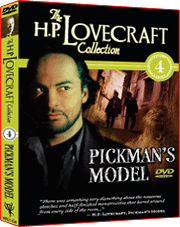
hplc04.gifJust saw the latest DVD from Lurker Films, Pickman’s Model. This disk presents with not one by three versions of the story! The featured presentation is from Chilean Director Ricardo Harrington and gives us a modern, if somewhat distinctively Latin interpretation of the story. It is a rich, primal version of the story, loaded with mood and animal fear. On the other end of the spectrum, we have an Austinite Cathy Welch’s version, shot in black and white and while modernized to the 1980’s, attempts to remain more faithful to the original Lovecraft story, though is marred by unexceptional acting on part of titler character. To round out the offerings is Giovanni Furore’s Italian version of the story with rich sets, professional photography and lighting, and decent acting. Bonuses include Geoffrey Clark’s animated version of In the Vault and Djie Han Thung’s surreal Between the Stars.
More H.P. Lovecraft Biography

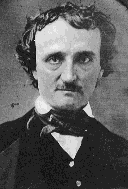
poe1a.gifThree useful essays on H.P. Lovecraft’s background are readily available on the web and are worth a read. The first, by Lovecraft circle member Robert Bloch (1917-1994) best known as the author of Psycho, labors to compare the lives & works of Lovecraft and Edgar Allan Poe. Bloch’s essay was was first published in Ambrosia #2 (August, 1973), and he rejects the simplistic superficial comparisons of their works and looks at the men’s similarities of character. The full content of the essay is printed here: http://alangullette.com/lit/hpl/bloch.htm.
gent.jpgThe second essay, by Alan Gullette, takes us on a walk through Loveraft’s literary works in relation to his life. A concise essay, Alan covers many of the key elements of Lovecraft’s literary achievements. The essay can be found here: http://alangullette.com/lit/hpl/gent.htm.

The third essay is a fairly complete rendering of H.P. Lovecraft’s life. Originally written by noted Lovecraft scholar S.T. Joshi for the H.P. Lovecraft Centennial Guidebook, it is now hosted by the H.P. Lovecraft Archives. Like most of Joshi’s work, this piece is scholastically well researched with considerable insight into the events of Lovecraft’s. The essay is posted here: http://www.hplovecraft.com/life/biograph.asp. The more detailed and voluminous biography, H.P. Lovecraft: A Life weighs in at 700+ pages and was published by Joshi in 1996, remains one of the most detailed and heavily researched biographies of Lovecraft.

Tags: , ,

Who Was H. P. Lovecraft?

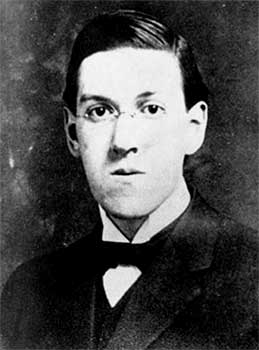
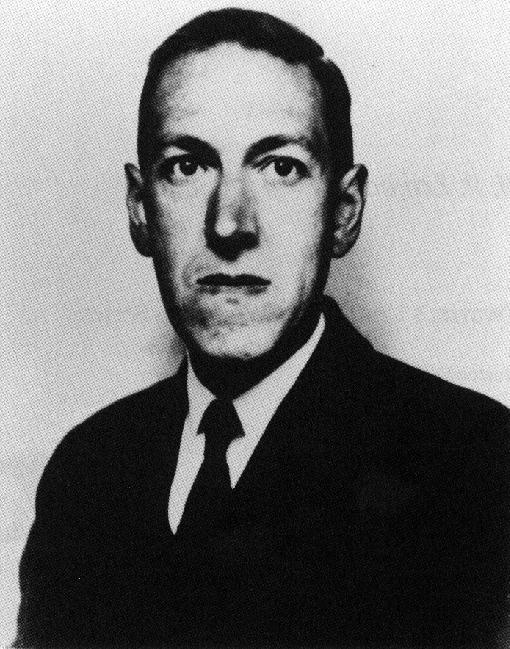
Howard_Phillips_Lovecraft___circa_1916.jpgFor those who came in late, Lovecraft Forest is named for the American writer H. P. Lovecraft.

Howard Phillips Lovecraft (1890-1937) worked mostly during the era of Pulp magazines, publishing frequently from 1905 to 1935. Largely unknown and unappreciated in his own time, his works quickly found a circle of follower and admirers including Robert Bloch, Stephen King, Bentley Little, and Joe R. Lansdale. Many fans of the American horror story look to him as the logical successor of Edgar Allan Poe. He also frequently corresponded with many contemporary writers of the period including August Derleth, Clark Ashton Smith, and Robert E. Howard.

Lovecraft is a complicated writer, heavily influenced by the increasing of scientific, mechanical, and relativistic influences of the time and the subsequent diminishing of religious fervor that marked the preceding years. He stories frequently deal with the horror of a purely nihilistic universe, such as in stories like Herbert West: Reanimator (1922) and disinterested alien gods for which mankind is little more than insects, such as in Call of Cthulhu (1926.) Of my favorite works are the historical pieces of past horrors, such as the magnificent Case of Charles Dexter Ward (1927.) His “Dream Cycle” work (chiefly 1920-27) tend to reflect the influence of Lord Dunsany’s works and features his classic, The Dream-Quest of Unknown Kadath (1926).

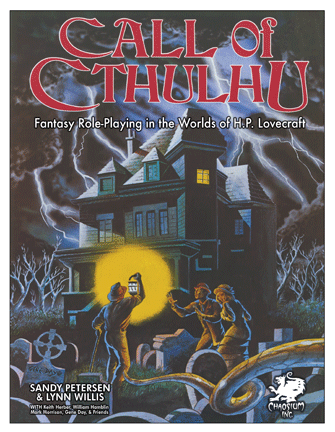
2009h.gifHe is also credited with much of the literary philosophy of Cosmicism, which usually holds that the universe lacks a recognizable God and the universe, though potentially populated with other beings, is chiefly indifferent to the activities of human beings. His chief contributions to subsequent horror writers including the Cthulhu mythos and the famous literary device, the infamous book Necronomicon. Development of a fantasy roleplaying game by Chaosium named for Call of the Cthulhu, has introduced Lovecrafts universe to an entirely new generation of fans. Introduced in 1979, the game is now in its 6th edition and celebrating it’s 25th anniversary.

Wikisource_logo.pngAn excellent introduction to Lovecraft can be found the Wikipedia article on his life and work here. Many of his works, now in the public domain, have been made accessible through WikiSource here.

Tags: , , ,